
Full-time for image rights companies? What the new UK tax rules mean for agents, artists and athletes
28.05.26
Separating salary from brand value: how image rights companies work
For years, image rights companies have occupied a complex but valuable space in the UK tax landscape. Used properly, they have allowed athletes, entertainers and other public figures to separate income earned from their personal brand from income earned for doing their day job.

Strictly, the UK does not recognise a freestanding legal “image right”. The term is generally used to describe a bundle of contractual and intellectual property rights, such as name, likeness, goodwill, trademarks and copyright.
Historically, where the arrangements were genuine and commercially supportable, image rights companies have allowed brand-related income to be taxed separately from employment earnings, often within a corporate structure rather than through payroll.
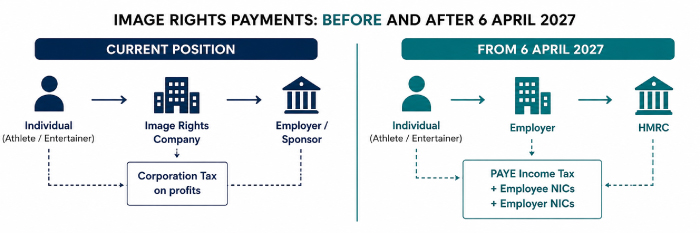
The typical IP Co, or image rights company, structure works like this: the individual assigns or licenses brand-related rights to a company. That company then licenses those rights to third parties, which may include sponsors, broadcasters, advertisers or, crucially, the individual’s employer. HMRC’s current guidance recognises that image rights companies may license the use of an individual’s image to commercial partners, including an employer, and that a UK-resident image rights company pays Corporation Tax on its profits.

In commercial terms, the logic is simple. A footballer’s playing salary is paid for playing football. A separate payment to an image rights company is said to be paid for the club’s right to use the player’s name, image and reputation in marketing, sponsorship and merchandising. For a genuinely bankable star, that distinction can be real. A global player may have a brand that exists independently of the club, with the player’s value to the club extending well beyond their actions on the pitch.
The difficulty is that the line between “brand income” and “employment reward” can be painfully thin. If the club is paying the money, the agreement runs alongside the playing contract and the amounts are negotiated as part of the overall package, HMRC will naturally ask whether the payment is really for image exploitation, or whether, in substance, it is additional reward for the individual’s employment.
Why are the rules changing?
Recently, this distinction between “brand” and “employment” income has been identified as a vehicle for reducing the UK tax gap, being the difference between the amount of tax that should, in theory, be paid to HMRC and the amount actually collected.
At Budget 2025, the Government announced that it would legislate to clarify the tax treatment of image rights, so that all image rights payments related to an employment are treated as taxable employment income and subject to Income Tax, employer National Insurance contributions and employee National Insurance contributions. The measure is due to be legislated for in Finance Bill 2026-27 and to take effect from 6 April 2027.
If it is employment-linked, PAYE and Class 1 NICs apply
The current position has always depended heavily on commercial reality. HMRC says that where an employer and an image rights company enter into an agreement for promotional services, there must be commercial justification for distinguishing between payment for employment duties and payment for promotional services.
Under the current approach, a great deal depends on valuation evidence, contract drafting, actual exploitation, board records and whether the employer can show that it received real commercial value. That creates scope for dispute.
The proposed reform turns that facts-and-evidence battle into a simpler rule: if the image rights payment is related to employment, it is employment income.
What does this mean for existing image rights structures?
First, it is important to note that a genuinely independent endorsement deal, negotiated outside the employment package and not dependent on the employer relationship, may still have a life outside the new legislation. For example, a personal boot deal, a fragrance campaign or an overseas endorsement advertisement could still be structured through a company where the facts support that treatment.

However, if the commercial reality points back to the employment, the new rule is designed to pull the payment into PAYE.
For existing employer-funded arrangements, the direction of travel is clear. The classic club-to-IP Co model is unlikely to provide the same tax result for payments made from 6 April 2027.
Unless the final legislation provides transitional protection, existing contracts should not be assumed to be protected simply because they were signed before 6 April 2027. The Government’s published description says the measure applies from 6 April 2027 and is aimed at all image rights payments related to employment.
That has practical consequences. Employers may need to budget for employer NICs. Individuals may need to model the effect of Income Tax and employee NICs. Agents will need to revisit pre-agreed contractual clauses. Clubs and employers may find that what was once treated as a commercial rights fee becomes part of the employment cost base.
Ensuring your position is efficient, commercially viable and compliant
Our advisers have extensive experience across the sports, entertainment and private client industries. Whether it is a specific tax-focused question or a more general query about your or your business’s wider financial strategy, we are always happy to discuss over an initial meeting, completely free of charge.


Insights
Our insights and ideas on managing money and understanding the markets.